The Chain of Survival: Strained but Not Broken
This story appeared in the July 2025 issue of “Dispatches.“
LifeFlight of Maine is one link in the chain of survival for those facing critical illness or injury, and that chain is straining. It has been for years.
In 2015, LifeFlight of Maine transported 1,633 patients. In 2020, LifeFlight transported 2,130 patients. In 2024, LifeFlight transported 2,743 patients. LifeFlight is expected to exceed that number significantly in 2025.
During those same years, ten hospitals in Maine closed their labor and delivery services. Many hospitals reduced services offered, decreased available staff, or delayed facility repairs or equipment upgrades for lack of funding. One hospital closed entirely. A June 2025 report from the Center for Healthcare Quality and Payment Reform stated that 12 of Maine’s 24 hospitals that are considered “rural” are at risk of closing (50 percent), with five of those at “immediate risk.” Similarly, EMS services across the state have been stretched, downsized, dispersed, and shuttered. The Maine Legislature’s Blue Ribbon Commission on EMS in 2022 estimated that there is a $70 million annual shortfall across EMS agencies statewide. These financial challenges far exceed any individual hospital or EMS agency. They are structural, national, and highly complex.
For patients, especially those in more rural parts of the state — which is most of Maine — that means traveling farther than they had to ten years ago to get the care they need. When calling 911, it may take an ambulance crew longer to reach them than it would have in a previous decade. As anyone who has ever been injured in the backcountry or waited for hours in an emergency room can attest, those minutes can feel interminable. For the most critically ill and injured people, time can have adverse effects on healthcare outcomes.
The healthcare environment in Maine is challenged, which puts pressure on all providers, including LifeFlight of Maine, which plays a critical role in connecting people to the care they need. A multitude of factors is contributing to the current situation: funding in general, the high cost of healthcare, public policy, population demographics, labor shortages, and even a lack of affordable housing.

Rural medical services, both pre-hospital (EMS) and in-hospital, rely heavily on reimbursements from Medicare and MaineCare (Maine’s Medicaid program), which have not kept pace with increases in healthcare costs. In many cases, providers are reimbursed for services at a loss.
Maine holds one superlative among the 50 states which uniquely contributes to this challenge: its population is the oldest in the country, which also means it has the highest percentage of Medicare beneficiaries relative to its population — 26 percent. “Some of this is good news,” says a 2024 report from the Maine Department of Administrative and Financial Services. “People are living longer. Maine saw its largest increase as a share of the population in the 75-79 age group.” But an older population also means more healthcare.
Labor shortages in Maine in recent years are well documented, whether in hospitality and tourism or in healthcare. This, too, is creating challenges for Maine’s medical system. A 2024 study by the Maine Nursing Action Coalition estimated that by 2030 Maine will be short 2,800 nurses. Even if schools in Maine could train more nurses and had students to fill those spots, recruiting those nurses to work in rural hospitals isn’t straightforward. Like qualified nurses, housing is also in short supply in Maine. Speaking in May 2025 on a panel at Colby College hosted by The Maine Monitor, Michael Tyler, who is a managing partner of Sandy River Company, a real estate firm, and chair of the board of the Maine Health Care Association, said: “If people can’t afford to live here, how can we expect to increase the workforce? It is impossible.” To compensate, hospitals turn to traveling nurses to fill critical staff positions, which is considerably more expensive and not a viable long-term solution to the challenge.
So, where does LifeFlight of Maine come into play, and why has it seen such significant increases in its services?
The simple answer is mathematic: an older population increases demand for healthcare services as economic forces diminish the supply of those same services. Less access to healthcare, particularly primary care and early interventions, leads to more sick people and to people who are sicker.
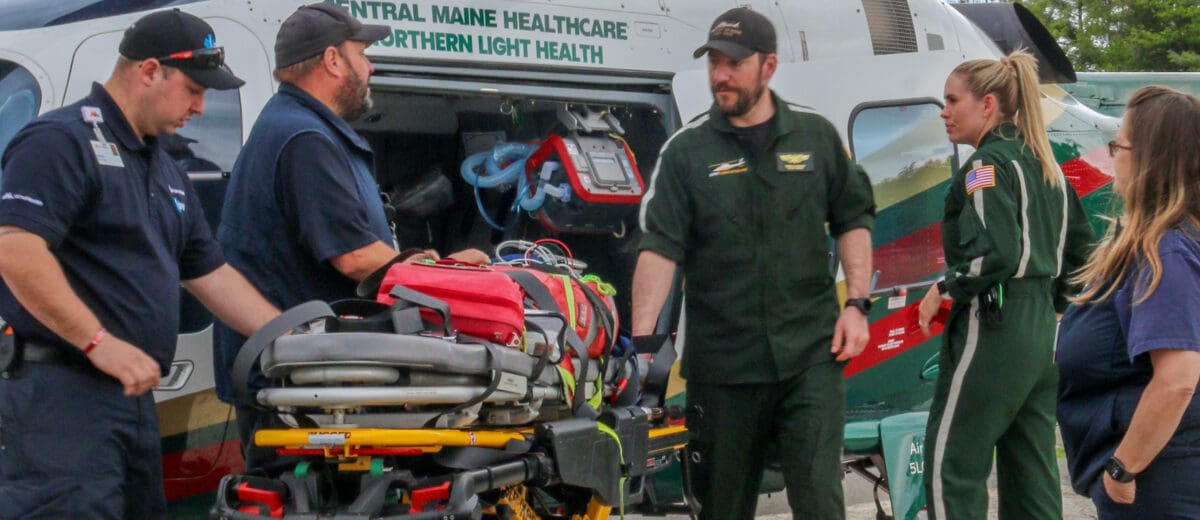
“Smaller hospitals are seeing an increased volume of higher acuity patients more often,” said Patrick Perrault, clinical base manager for LifeFlight’s Lewiston base. “The volume of critically ill patients is taxing these places.” As a critical care transport provider, LifeFlight essentially operates mobile ICUs. One critically ill or injured patient can occupy all the resources of a smaller community hospital. These facilities rely on LifeFlight to provide backup and move those patients to larger medical centers offering healthcare services to match the patient’s needs.
Patrick, a Maine native, has worked as a flight nurse at LifeFlight of Maine since 2013. He has transported a patient from every single hospital in the state. He worked for LifeFlight through the pandemic. He has seen Maine’s healthcare landscape shift firsthand. He’s aware of the research, and he also sees it on shift with the flight crew. “The other piece of it is that people are just getting older,” Patrick said. “People seem sicker than they used to be.”
As the headwinds facing Maine’s healthcare system continue, LifeFlight expects the demand for its services to continue to rise. From January through April 2025, LifeFlight transported a patient on average every three hours and 14 minutes — and that was before the summer season began, when demand for LifeFlight’s services further increases. In May, LifeFlight experienced multiple days in which it transported more than a dozen patients and covered more than 1,000 miles in a 24-hour period.
There is no singular solution to these challenges. Maine’s hospitals and EMS agencies are full of highly skilled, compassionate, and dedicated clinicians who work tirelessly to provide the best care they can for patients. Maine’s healthcare leaders are creative, frugal, and staunch advocates for building a better healthcare system for Maine. Maine needs more investment in healthcare, and it needs innovation. “Innovation has been at the core of LifeFlight’s genome since our inception,” said Thomas Judge, the founding executive director of LifeFlight. “We were established to address the gaps in critical, time-sensitive care, and we have always responded to the constant shift in needs of Maine’s patients with new therapies in cardiac, stroke, pediatric, neonatal, and respiratory care and by filling gaps in the chain of survival when minutes matter.”
Maine’s healthcare system will look different in the next decade than it does today — hopefully, it will be much stronger. LifeFlight will continue to lead, as it always has, with the speed, dedication, compassion, and commitment to excellence that the people of Maine deserve.