LifeFlight’s Critical Care Academy Provides Training to Clinicians Across Maine
“It raises everybody’s game, whether they are planning to come work for LifeFlight or not,” Tom Gutow said of LifeFlight’s Critical Care Academy. Tom is LifeFlight’s Senior Clinical Educator. He has trained dozens of critical care clinicians, colleagues at both LifeFlight and medical centers around the state, including the six people who comprised the most recent cohort of the Academy in November 2025. “The experience makes people better at doing their job and raises the level of care that patients throughout Maine receive, because of the knowledge and technical skill clinicians gain from the experience.”
Lisa Trainor graduated from nursing school in May of 2020 and started working at Maine Medical Center in Portland. She spent two years as a nurse on the surgical oncology floor before moving to the cardiac ICU unit. There, she saw LifeFlight crews in action and began to think about possibly wanting to join the team. She was one of the clinicians who recently completed the Academy.
“Even if I don’t apply or get a job at LifeFlight in the future,” Lisa said, “it has changed my perspective on my responsibility as an experienced nurse on the unit, and it’s lit a fire under me. I had this amazing gift of this free education, and now I feel like it’s a torch to pass on to other nurses.”
Of the six participants in this most recent Academy cohort, three are LifeFlight of Maine clinicians progressing through LifeFlight’s orientation process; one is an emergency medicine physician at MaineGeneral Hospital; one is a paramedic with the Scarborough Fire Department, and the sixth is Lisa, who is an ICU nurse at Maine Med in Portland.
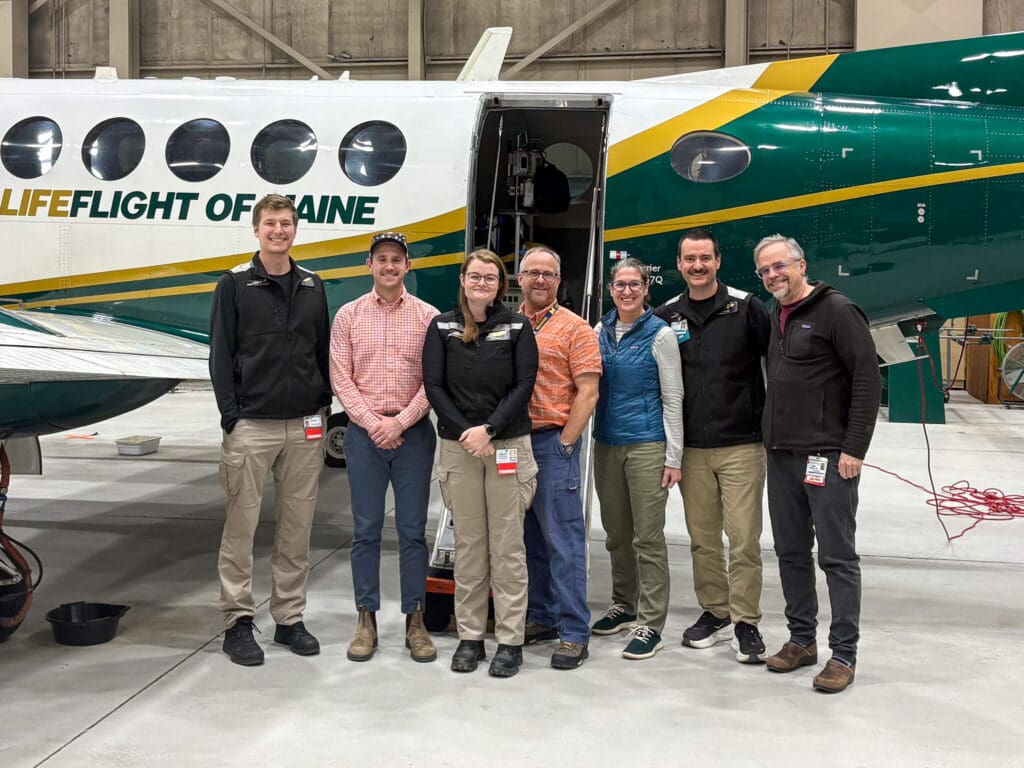
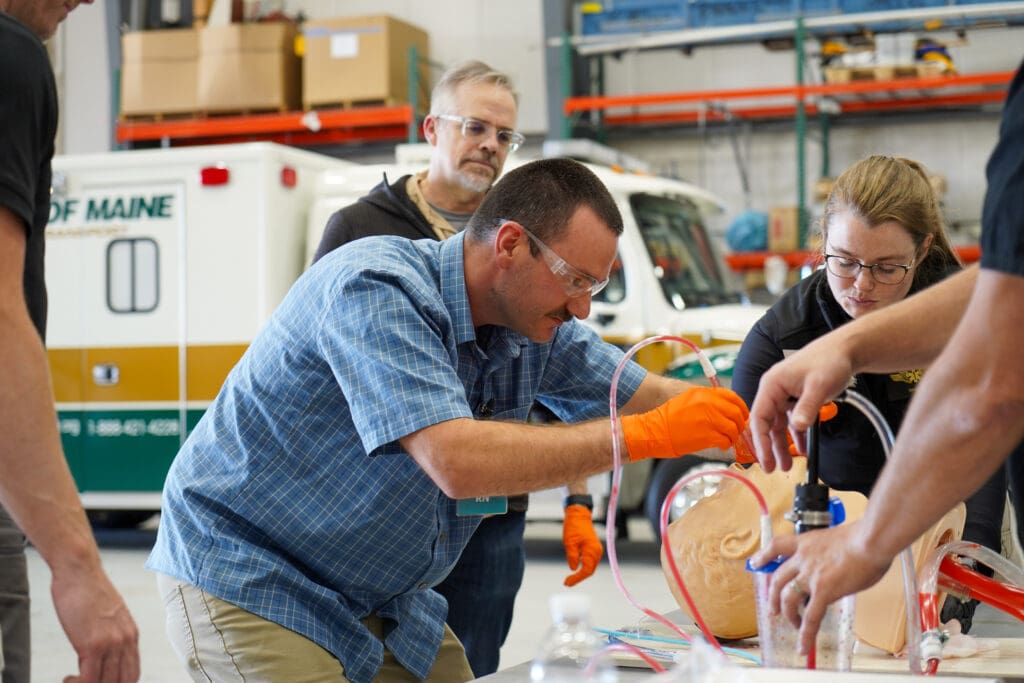
Left: The most recent Academy Cohort. Photo courtesy of Sam Brown. Right: Participants practice their clinical skills.
The Critical Care Academy was established in 2015 and is available both to LifeFlight staff and to clinicians across Maine. The goal of the program is to help transform the practice of Maine’s critical care workforce by teaching new skills to improve care in our hospitals and for our partner EMS agencies. The program also creates opportunities for clinicians to be more prepared to care for critically ill or injured patients.
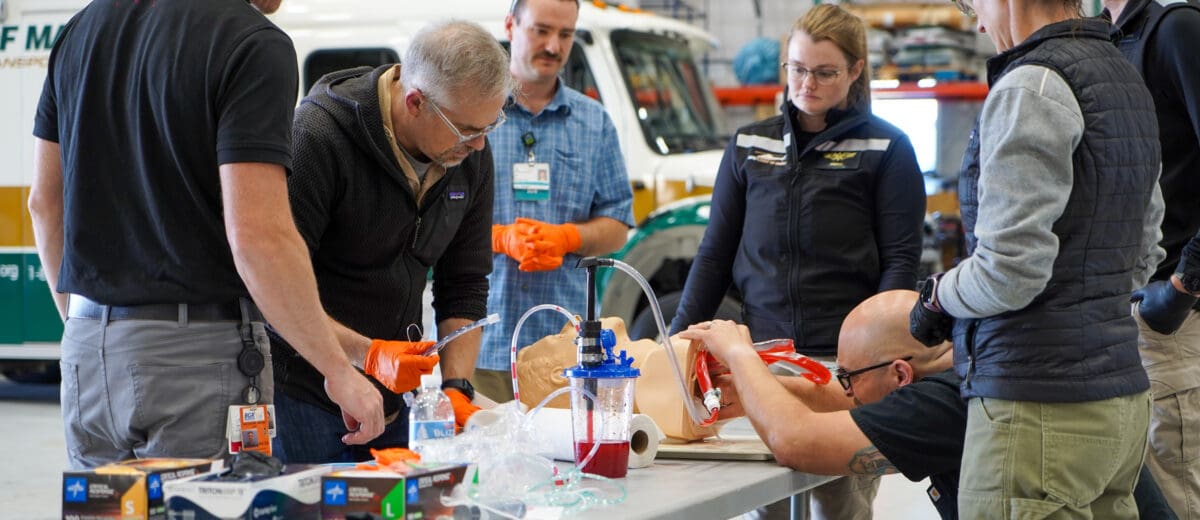
Classes at the Academy are taught by current LifeFlight clinicians as well as physicians and other experts across Maine. The Academy is broken into intensive, day-long modules spread over multiple weeks. The sessions focus on situational assessment, procedural skills, critical thinking, and developing a team approach. The subject matter covered includes airway and ventilation management, cardiac and hemodynamic management, assessment and care of children, and specific skills in airways, trauma, cardiac care, and ultrasound.
LifeFlight clinicians spend months going through on-the-job training in orientation. As part of this process, every new LifeFlight clinician is required to complete the Academy.
“It’s important for LifeFlight because it makes sure that we establish a consistent set of foundational knowledge for all of our staff from which we then move into our practice,” said Tom.
“We have found one of the greatest benefits of training like this has been the camaraderie established among the LifeFlight staff going through it. It has really improved relationships among LifeFlight’s clinicians and partners at other agencies and healthcare facilities,” added Chuck Hogan, LifeFlight’s Chief Clinical Officer.
Clinicians from outside the organization are often referred to the Academy by clinical educators at LifeFlight. In some instances, participants have previously applied to be a flight nurse or paramedic but did not quite have the required skills or experience. These applicants are often then invited to join the Academy as a way to sharpen their skills and to learn more about the role of a LifeFlight clinician.
“It’s a great pathway for people who are interested in coming to work for us in the future because it gives them an opportunity to see what it is we do, how we think about education, and how we address these critical care topics,” said Tom.
During the Academy, Lisa worked directly with her peers to sharpen her skills as an ICU nurse and to learn new techniques that are out of her scope of practice. It’s a space to share ideas, ask questions, and dig into the medical research.
“My favorite part of the Academy is being in a room full of inquisitive, like-minded people who are interested in learning more about their field and about critical care medicine and what we’re able to provide our patients,” shared Lisa. “I have been blown away by the program. It’s absolutely astounding. The amount of work that LifeFlight puts into this Academy, I can’t believe that they offer it to community members free of charge,” she added.
The Critical Care Academy is funded by generous donors. It is free for all participants, who receive continuing education credits for taking part in the course.
For Lisa, the Academy has also reignited her love for nursing.
“I’ve really been struggling with some burnout aspects at the bedside,” shared Lisa. “Being in the Academy has inspired me to start a new project on my unit. I’m going to work with some of the cardiovascular critical care attendings to create a microlearning program for our night shift to try to bring people up to speed a little bit faster.”
Over the years, the course has provided training to dozens of clinicians — both from LifeFlight and the surrounding community — improving care throughout Maine’s healthcare system.